Wednesday, February 15, 2017

Rally Rewind - EMC Kabale Rally 2016 : Part 2 - The Stages


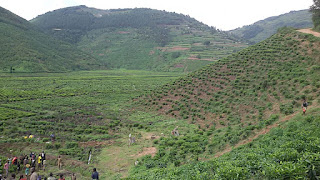
Cs1/4 Bunyonyi – 12 kms – This stage finishes at the Lake Bunyonyi resort but does not provide scenic views of the lake, that bragging right belongs to another stage. This stage runs along the lower slopes overlooking Kabale town, on wide and fairly straight roads.  Not surprisingly the fastest stage of the rally.  It finishes with a super steep downhill and fast brows that bring you back into town along the Kisoro road.


Cs2/5/9 Kitagata – 27 kms -  A long liaison section along the Kisoro road precedes this stage and takes us deeper and higher into the hills.  It has very narrow, tight, rough and un-protected hairpin bends as you spiral up the hills, a bit rough on the way up through lumberjack territory for about 14kms. The road opens and maintains altitude for about 4 kms before a rollercoaster descent on wide, smooth, rounder medium speed bends to the FF which is itself near the start.


Cs3/6/8 Stadium – 1.5kms – This is a spectator special stage, on a grass track in the Kabale town stadium right in the centre of town.  Perhaps because the organisers figured you can catch all the action from the adjacent slopes and without setting foot inside the arena, they decided against a gate charge. How do you make a pitch of 100m length into a stage more than 1 km long. Answer – you create 15 hairpins 


Cs7/10 Katuna 29 kms – a 20 km drive south takes you to katuna border post, thru the border gates and west thru the Katuna village. It starts in low lying areas and ascends gently at first and then sharply thru narrow, stony cliff hanger hairpin bends as it makes its way towards Lake Bunyonyi. Towards the end, it joins the Bunyonyi stage.   


Cs8 Heisesero – 27 kms – stage starts at Heisesero on the Kisoro road and on the northern most tip of the Lake Bunyonyi, the only point where the highway touches the lake.  You can actually touch the water here and because of the sharp bends in the terrain the lake looks like a pond at this point.  The start is very similar to Kitagata – very narrow, rough, tight hairpin bends, and no barriers, the difference being drops into the water as opposed to fertile gardens – within 700m you wake up to the reality that if you step off the road and there isn’t much to stop you, you are ending up in the deepest lake in the world.  It is a scary ascent when the road is say 50m off the level of the lake.  It is suicidal when the road climbs to maybe 200m above lake level, a point where you can mistake the little islands on the lake for fishing boats. The entire stage traces about half of the eastern bank of the lake. Towards the end it leaves the lake and descends gently then sharply on very slippery red earth fertile soils towards Bubare on the Kisoro road.

Rugarama – This stage is very similar to Heisesero and Kitagata, only steeper.  It also adds cracks in the narrow pavement and because it was raining, there was no telling if the pavement would get washed away during the rally.  It was cancelled.  

It was obvious after the recce that this was going to be the championships toughest. But even before it began, we would get premonitions of things to come

Look out for Part 3: Premonitions/Weird moments and Part 4 for the Entry List

Rally Rewind - EMC Kabale Rally 2016 : Part 1 - The Anticipation


While the prospect of a rally in Kabale was widely welcomed, there was some controversy surrounding it’s organisation.  For starters it didn’t make sense that the Jinja based Eastern Motor Club was organising a rally all the way West in Kabale.  Secondly the original date of the rally on Easter weekend was sharing a date with another motor cross event in Kampala - something that the sporting calendar planners had hitherto said was not allowed, however the long weekend would see the rally run on Good Friday and Saturday and leave Sunday for traveling.  At the last minute the rally was moved to a later date which did not go down well with many competitors who had prepared and would be unduly inconvenienced by the change.   The organisers cited a health scare in the area. 

Kabale was nouveau:


The itinerary was different. In sharp contrast to normal Uganda rallies where we spend the Saturday morning and afternoon pulling grass out of the super special grounds because we only cover less than 5 kms the entire day, for kabale, Saturday was big business.  By 9 am we were already in the stages proper and by 10 30 am we had completed the first service stop after the first loop of 3 stages totaling 42 kms and 25%  of the rally distance . By the time we went to bed on Saturday, we would have covered a whopping 110 kms of competitive stages with more stages to come on Sunday.

Other than the Lubiri palace super special, we had never had a super special bang in the middle of and along the high street of a major town.  The super special was super accessible not just because it was free entry but also because of the elevated landscapes surrounding it, you could catch the action without entering the stadium.

The stages were very different from anything we were used to.  We had expected winding roads and power sapping altitude but nothing like what we actually encountered.  We had narrow, rough and unimaginably tucked into the terrain, extremely tight and therefore slow sections. I don’t remember anyone complaining after the power sapped out by the altitude as the last thing you needed was a barking bronco on those unbridled cliff hangers.  We also had stages running along the highest and deepest lake in the world – scenic views if you forget the insanity that it required to drive it.  

Continues in Part 2: The Stages

Sunday, February 5, 2017

2017 MMC Lato Milk rally, Mbarara

This time last week it was impossible to imagine we would be here this week as not just finishers but  the celebrated winners of the first round of the Uganda national rally championship, the Lato milk sponsored and Mbarara-based event.  I was down with the worst case of Man flu which I had battled for 2 weeks.  I was also dealing with a bereavement in the family (RIP Hajat Anisha).  Much was uncertain and what little was, did not go according to plan.

We had planned to map and install a new ECU that would give us Bang-Bang, raise the power produced by the engine and the noise that gets the fans hearts racing.  This did not happen as the tuner we had booked changed plans.  We had also imported new tyres and suspension parts but again these had arrived in the country when we had not done any pre-customs clearance work and so were not with us by the time we loaded up to go to Mbarara.  I had only done 50% of the recce and my health was improving ever so slowly i was not sure I would be able to do more than 50% of the actual rally.

When the ceremonies for the start of the event were underway there was no sign of rain but by the time the convoy of rally cars entered the Kakyeka stadium, venue for the super special stage, clouds had gathered and a light drizzle had commenced.  By the time the first car took to the stage, a full blown storm was in session.  The start list had 40 cars and although we were seeded 9th, the super special stage would run in reverse order meaning we had the benefit of seeing other drivers navigating the grass and mud bath that the track had become.


When our turn came, we followed the approach we had decided before the rally, which was conservative.  All too often in the season before we had taken an aggressive start and ended up losing too much time or even a broken car and some times both. On this occasion we would end the day in 7th overall and only 16 seconds adrift of rally favourite, three-time and defending national rally champion Jas Mangat.  However, Jas was only in 3rd overall behind Duncan Mubiru in second and Kuku Ranjit overnight rally leader.  Sebuguzi Ronald had picked a 5 minute penalty for missing a run due to a broken fan belt.  Our car (Edna) was in tip-top condition and my spirits were up despite nursing a headache I had carried over from 2 days before.  I popped a pill and retired early determined to see off the headache.

By morning the headache was gone.  I could hear a light buzz outside my room at the Lake View Resort and when I pulled the curtain I could see it was raining  and apparently had done so half the night.  If the rain we had seen in the town the day before and this morning had also pounded the stages, we were in for a shocker - seeing as the recce had been completed in bone dry conditions.  I then prayed that the rain would stop by rally start so that even if we the road was wet, we would have clear visibility at the very least.  That prayer was not answered.  The rain would fall and even increase pace from the moment we entered the last stage up until the start of the very last stage. The upside of this was that for me who had done only 50% of the recce, the rain was in fact an equalising factor, these stages would look jus as strange to those who had gone thru them twice or even four times.

The start order had Jas Mangat, Hassan Alwi, Arthur Blick Jr, Christakis Fitidis, Ronald Ssebuguzi, Godfrey Lubega, Yasin Nasser, Duncan Mubiru, Omar Mayanja and Kuku Ranjit as the top ten and for the main leg we would be attacking the stages in that order.  I lowered my tire pressure and wished I had a suspension setup for the wet but I didn't.  Luckily my heater blower works like new - the benefit of buying a car from a winter nation.  I had clear vision, in the circumstances, considering the sky was completely black and visibility was down to a couple hundred meters.

A few kms into cs2 (first of day2) the Kakoba - Sanga 40km stage, we encountered Yasin Nasser fresh from a roll on a slippy and narrow downhill, we slowed not just to check both drivers were ok but also because there was not much space to negotiate thru.  A message had been delivered to us to watch  our step.  After about 15km the stage touches Biharwe town and a hairpin right connects us to the road to Sanga thru cow country.  For another 10 or so km the road is wide and smooth and interspersed with high speed jumps and holes before it suddenly switches back to cow country road, red and black earth and single lanes lined with trees, tree stumps and anthills.  The change or lets say loss or complete degeneration of grip for this last section is impossible to imagine.  Every driver reported suspected differential failure at the end which only shows it was simply the road treating everyone the same.  We soldiered thru it and it was only the last 2 km that caught us when we spun and lost about 30 seconds trying to get the car to face in the correct direction again.  From there we tiptoed to the end of the stage where we were surprised to clock the 3rd fastest time behind Jas and Hassan and ahead of Duncan, Sebuguzi and Arthur Blick Jr.  Jas had taken the lead, followed by Hassan with Duncan in third but only 5 seconds ahead of us in 4th.

In service at Sanga we found a broken rear stabiliser bar which we eliminated entirely and a rear left damper which we replaced.  Next up were two stages to be done together before the next service stop.  The first and toughest (at least during the recce) was the 30km Sanga-Ahakyapa stage which starts with a blast of 12km of dead straight ascents and descents, followed by 2km of grave deep trenches, 8 kms of medium trenches and holes and finishes with about 8kms of near dead straight ascents and descents.  We were now running 8th on the road with all cars apart from Yasin Nasser ahead of us still running and in the original start order.  On the stage, the grip was not bad and the only surprise was finding that practically all the anthills had been removed (but due to poor visibility you would only confirm this after slowing down for them).

We cleared the stage with a bulged and about to blow tyre in 21 minutes exactly, and 4th fastest behind  Sebuguzi, Duncan and Jas with the first 2 being a whopping 120 and 85 seconds respectively faster.  Jas was only 14 s faster on this stage and had lost the overall lead of the rally to Duncan Mubiru, Hassan was in 3rd and we were holding steady in 4th.  Sebuguzi was smarting from a 5 minute penalty the night before when he did not complete the super special stage but was now firmly back in the top 10 and hunting. Duncan had also overtaken Lubega in the stage and Sebuguzi had overtaken Fitidis.  For the next stage, Lubega would request that Duncan runs ahead of him and we would now run behind Lubega.

The second of the two stages was the 12km Akageti-Ahakyapa  stage which runs thru Lake Mburo National park.  It starts out on smooth wide and winding roads before branching off into cow country where it finishes on black soil and in grip conditions worse than we had seen on cs2.  We would complete this stage 3rd fastest behind Jas and Duncan and reduce our gap to Hassan in 3rd to just 9 seconds.  Jas would also retake the lead from Duncan and take a slender 5 second advantage into the next stage whil
e Duncan' advantage over Hassan was now 34 seconds.  We checked in to service with no problems to report and I was on the whole much happier with the car.  After service we had another two stages to be run together.  Each of these stages was more than 20 kms and for fear of catching up with Lubega we asked to run on a 4 minute interval behind him.

Cs5 (the fourth of the day) was 20 kms long, starts at Sanga and finishes at Sanga on the side of the kampala-mbarara highway.  Very similar to Akageti-Ahakyapa in character it starts on wide smooth roads before transitioning and finishing in black and clay soils in cow country.  We found Lubega at the FF control of the stage vindicating our decision to run on 4 rather than 3 minutes interval.  We had cleared the stage 4th fastest behind Jas, Hassan and Sebuguzi.  Jas had extended his lead from Duncan to 88 seconds while Hassan was now pressing Duncan from behind by just 6 seconds.  We were holding fort in 4th overall but now 43 seconds behind Hassan but ahead of Arthur Blick Jr while Sebuguzi had now climbed up to 7th overall.

Cs6 starts at Sanga at the same point as Cs3 but goes separate ways at the 12km mark and this time onto winding roads that are a mix between fast wide and narrow-pot-holed roads which were now filled with water.  It is 26 kms long and generally the easiest stage for the day.  Sebuguzi posted another blistering time in this one ahead of us in 2nd fastest, Jas and Hassan in 3rd and 4th.  Duncan lost more than 5 minutes due to overheating and lost his second overall in the provisional classification.  Even without a scratch time, with the falling back of Duncan, Jas had extended his lead to 130 seconds ahead of Hassan in second and Omar in 3rd a further 30s adrift.  Arthur Blick Jr was 4th but now dangerously in the bull's eye of a hard charging Sebuguzi.  We checked into service with broken front right damper and a bent right side rack end which caused our active center diff to mal-function during the previous stage and effectively leaving us with two-wheel drive.  We changed both broken parts but were unable to realign and re-calibrate the steering to eliminate the ACD mal-function.  However this is a problem we have driven around so many times before and here we only had one stage to go.

The final stage is 27 km long and starts at Kamatarisi near Biharwe, winds very slowly thru the kamatarisi village for about 4 kms before joining the wide road from BIiharwe near the Rushozi hairpin (at the coca cola sign) and takes us back to Kyamugorani on familiar wide and fast roads.  My team did not reveal that we were only 30s behind Hassan and I was under strict instructions to maintain pace (as opposed to raising it to attack 2nd place), we were in 3rd place and we would remain there if we got to the finish safely.  Perhaps Hassan did not know this or perhaps the conditions were just too treacherous on the first 3kms of the stage where we hit a tree stump that luckily for us only bent the sump guard and took out pieces of the body work.  This same tree stump or anthill (no one really knows) had minutes before taken out Arthur Blick Jr and Hassan with similar suspension damage.  We would now take 2nd place if we could navigate safely to the end.  We did not see the leading car of Jas Mangat at the Rushozi junction.  We slowed considerably and just drove till the end of the stage and to the finish point at Lake View Resort.  It was here that we discovered that Jas had not emerged from the stage and we had won the rally OVERALL!!!  It's really true what they say, 50% of success is showing up.

Duncan had also lost more time in the stage and now Sebuguzi was in 2nd overall, Duncan third, FItidis 4th and Byona 5th.  Arthur Blick Jr emerged from the stage after doing repairs for more than an hour to finish 17th overall.  The top ten was completed by Musa Kabega, Godfrey Lubega, Kuku Ranjit, Fred Busulwa and Dr Ashraf.   

This is yet another event that reinforces our peculiar strength in the wet and muddy conditions.  But even as we won, the real gladiators of these conditions are the thousands of fans who took to the stages and weathered the storm to see us thru.  Our newly installed V-powered engine also ran faultlessly in the cold and wet conditions.  We owe this win to our sponsoring partners Vivo Energy, Guvnor Entertainment and Nippon Plant and Equipment hire as well as to each member of the CleanLines Racing Team - Hussein Mukuye, Paul Ekudu, Vincent Matovu, Kasozi, Ipsum, and Ivan.  We now lead the 2017 championship with 100 points, we shall be running higher in the start order meaning more visibility for our fans and partners.  Look out for the surprises that we shall unveil in Kabale on the weekend of March 3-5th.

Thursday, January 12, 2017

How to drive a 6 speed FWD Normally aspirated car - coming from a 5 speed 4WD Turbo charged one

1. Take off /Launch - not important, will only result in wheel spin and will cost drive shafts. Rev lightly and do not exceed the mid range, dump the clutch, once the wheel spin subsides, the revs drop but then quickly pick up.  Shift to second once you get past the mid-range
2. Gear shifts - You have to use the entire rev range ie up to the red line if you are really pushing.  Best if you install a shift light because it becomes a problem keeping your eyes on both the road and the rev counter
3. Pace noting system and attendant driving - best to use a gear based system.  coming from a descriptive system of notes to gear numbers is not so hard.  Coming from a 5 speed to a 6 speed transmission is a bigger problem. Best to ignore no.6 as it is too weak anyway and only works on very long stretches.  So I stick to the descriptive system and drive the 5 gears as I would a 5 speed.  In any case given that every hesitation on power results in a significant drop in revs and power, it is better to fetch a lower gear that then keeps the revs up
4. Find a way of disabling ABS without disrupting the speed metering system.  I had to do the first rally with ABS on because I wanted to keep an eye on the speed.
5. Use the handbrake only on very slow and sharp corners.  You can still get away with deceleration drifts, left foot braking, scandinavian flicks.  it just feels as if every time you touch handbrake, while the car turns in easier, it just feels like it takes a while to overcome the inertia and inevitably results in more than desirable wheel spin at the front before the car starts accelerating again.
6. After long straights, brake late and use the gears to avoid locking up the wheels and slipping.

2010 KCB POAUR - winners and losers

The 2010 Edition of the KCB Pearl of Africa Rally – Winners and losers

Though it looks like the final result of last weekend’s KCB Pearl of Africa rally was taken out of my script (top 10 to watch), there were still a lot of revelations even for the seer in me. As it turned out, this rally could have been won by any of 3 people considering that a single puncture could have snatched the lead from event winner Jamie White. You also have to go back more than a few years to when podium finishers were separated by a couple of minutes. You probably have to go back many more years to a time when stages were won by 6 different drivers!!!

But such was the competitiveness of the Pearl that while Lwakataka was attacking from the front, Godfrey Lubega was attacking from the back to crown himself the King of Kiwoko – a stage he won both times it was run. Mark you, this Lubega (no relation to Charles) is only in his second season of competition. It is only mean people who say “you have all done well but there can only be one winner!” – for me, these are the winners:

Jamie White – For taking another basketful of ARC points and winning the rally outright even when he did not have to – following the retirement and poor luck of Jas Mangat and Giancarlo Davite. But by so doing, he has opened up the possibility of winning the ARC as early as May in Kigali.

Ronald Sebuguzi
Sebuguzi was constantly aware of the steep learning curve he was facing when he took delivery of his new car days to the start of the rally. Being able to exchange stage times and stage wins with arch rival Ponsiano Lwakataka was enough for him. But he got more just for trying and coming very close. At the end of the last competitive section, Lwakataka had beaten him by 7 seconds – before the roof caved in on Lwakataka and handed Sebuguzi a fat go at the 2010 NRC even after skipping the first round and forsaking 100 points when he did not go to Mbarara.

Nasser Mutebi
The dark (and poor cousin) horse of the rally, Nasser drove from the heart and won himself many hearts even before the rally was over. His combination of showmanship and preservation of the car had him up as high as 2nd overall at the mid-point of the rally. Nasser is also in only his second season of competition and was driving one of the older cars in the race. And when all was said and done, his effort handed him the overall lead of the 2010 NRC and a margin of 40 pts ahead of his closest challenger.

But you cannot have winners without losers, who are also many but I will stick to just 2:

Ponsiano Lwakataka
The mafu-mafu driver did all of us proud by sharing stage wins with the continent’s best and who knows what would have happened if he had not had that fatal encounter with cyclists. At the end of the last competitive section, Lwakataka had in fact finished in 2nd overall but failed to get his car to the ceremonial finish. And just like that he forfeited his claim on the podium but most importantly – dived from first on the 2010 NRC standings to an iffy 4th place – 80 pts shy of the lead. Lwakataka is also a loser for failing to challenge the people that had handed him a capital punishment (disqualification) when he completed all competitive stages even as drivers like Charles Muhangi and Susan Muwonge were given unprecedented chances at finishing with honors after missing stages.

Organiser
At the end of the day, a dark cloud hang over the rally with safety concerns being echoed across all news channels when they should have been hailing the winners, sponsors and fans. While I understand the technicalities of the sport’s regulation and recognise the near certainty that the organizer is indemnified in the event of accidents such as was witnessed last weekend, I believe that when lives are lost people should have some answers. The list of casualties could have been much higher if Godfrey Lubega had lost control of his car just 5 metres behind where he actually did at the Kiwoko TC – ultimately smashing 4 spectator cars and using them as a cushion to save his own life and keep him in the rally.

We also witnessed a skirmish when locals were bullied by safety marshals, marshals were “worked on”, reinforcements were dispatched from the service park to “avenge” the treatment, only for them to receive the same treatment! This is not only an embarrassment to the organizer, it is also an insult to the communities that host our events.

Organiser again
With only 17 starters and 9 real finishers (not counting the 5-minute rule cars) – this year’s edition of the POAUR probably has the record for the smallest number of starters – including the years when there was no sponsorship. For a rally that counts for the NRC, it beats my understanding that cars which normally compete in the NRC were not given a chance to compete and score in that category. This not only disenfranchised those competitors but also short-changed the sponsor. The Kenyan round which was held a month ago and sponsored by the same company, and to which the Ugandan organizers were famously hosted as observers, had more than 40 cars with almost half only competing in the national and 2WD championships.

Star of the Rally - Steven Byaruhanga
Clerk of Course Stephen Byaruhanga rose to the challenge for the second time in difficult times to design a course that had every driver wringing their hands at the thrill it promised. He delivered on that promise and also produced (in my humble opinion) the most hotly contested event in our rallying history. Stages were won by Mangat, White, Lwakataka, Lubega, Sebuguzi and Davite. There were position changes in the top 5 at the end of each stage. Retirements were mostly blamed on high speed off-road excursions rather than holes and trenches in the middle of the road. I pray that Byaruhanga is asked and he accepts (reluctantly of course) to pull this off again next year.

Tuesday, September 11, 2012

Grand Flip Flop

This is not intended to undermine the efforts of the organizer or the competitors. Fact is that what was billed as the Grand Masters Sprint was anything BUT,errrrr..with the possible exception of a Grand Father who won it. Ok, that was grande. 

To start with, the pre-event hype of Ponsiano Lwakataka being locked in a high stakes bet with Shafik Ssemujju was ineffective.  Real sportsmen do not bet on sports. Further, Lwakataka is a giant, Shafik is sold as a baby (the passage of time changes nothing).  Why would a grand master like Lwakataka pick on Ssemujju??  As it happened on the day, Lwakataka was not even paired with Ssemujju in what would be a head-to-head fight.  These are some of the deceptions that do nothing for the image of the sport.

However, a couple of old timers ...oops..Grande Masters were making a re-entry into competition.  Charles Muhangi who has been around was making probably his 2nd appearance in competition this year in his much envied Subaru Impreza N12.  Arthur Blick Jr who last competed in 2004 was however, the big news.  He had just been picked out of retirement by the Amin of the Rwenzori Rally Team to take the place of Edson Mungyereza in their erstwhile not-so-successful Subaru Impreza N10.  Arthur is on course to win his umpteenth motocross championship and would be riding first on the day to defend his lead against Asaf Naten and Maxim Van Pee who was away at school.

The rest of the entry list was the usual competitors led by NRC standings leader Jas Mangat (Subaru Impreza N12) and Ronald Ssebuguzi (Mitsubishi Lancer Evo IX), the only 2 people in with a real chance of winning this year's title.  Other fired up contenders included Christakis Fitidis (Subaru Impreza N12), Susan Muwonge (Subaru Impreza N10), John Consta (Subaru Impreza N8), Lwakataka (Subaru Impreza N8) and Duncan Mubiru (Mitsubishi Lancer Evo VIII).  Edson Mungyereza (Subaru Impreza v.5) also made the start although in the much older car that had not been seen in competition in a while.

No sooner had competition started than the heavens opened up.  The rainstorm was so heavy and powerful, the track was flooded within minutes.  I have written about the passion of rally fans and if there were any doubting thomases, this event proved it.  The controls and timing devices were blown away as well as any flags but everyone stayed put.  This writer got so wet and so cold that he almost bit his own tongue off but no one was moving.  After about 90 minutes the rain stopped and action resumed.  However, it was clear to me that there would be no time to complete the second running of the sprint as scheduled.

Back in July, Mohammed Essa and Jas Mangat had done so well on this track when they showed up with wet gravel tyres.  SO this time, Fitidis and Consta had followed suite even if in the morning when they showed up for the start the weather did not look too gloomy.  They were bang on the money however and the results showed.  Even as some favourites suffered turbo failure (Ssebuguzi) and failure to start (Shafik), many suffered wet weather and despite their efforts on dry gravel tyres, they could not match the speed of the wet-shod group.  Arthur Blick Jr who was expected to be shocked by the speed of the current protagonists was blown totally out of competition by the rain storm and posted 14th fastest on the first run.

On the first run, Fitidis put on a flawless display and showed no hesitation whatsoever on the water logged track.  Jas Mangat who is usually faster, hesitated more than once and the gap between him and the winner became too large to close on the second run.  However, this was not to be as dusk fell and the event had to be abandoned before all cars could make their second run.  The event therefore ended without the usual climax and fan fare of the winner being lifted sky-high by the fans.  Worse, there were no results announced and so, for the second consecutive time for an event held in Lubiri grounds, the results were to be determined in a conference room days later, a situation that can only increase the controversy surrounding motorsport in Uganda.  As I write this, I have read somewhere on Facebook that the results are out (oba where) and the prize giving ceremony will go ahead as planned tomorrow at Mambo Jambo in Mmengo.

Congratulations Mvuama (Grande) Papa on that sweet victory.  Never let the clouds get you down.

Wednesday, August 22, 2012

Sneaking out of retirement - A post mortem of the 2012 Eastern Motor Club Rally

Preparing to drive in anger for the first time in 5 years is worse than preparing to drive in anger for the first time ever. In the latter case, the driver is probably young and believes he is the best yet. Chest thumping and taking every car and driver opponent at face value, he thinks I can beat that..that too...that won't even last 3 kms ahead of me!!! Not so when you are on old hag coming out of retirement to enjoy (once again) the thrills and delights of racing against the clock and getting within a whisker of kissing a tree or somersaulting over an ant-hill. Even for a cool-as-a-cucumber competitor like myself (I have seen the most "fearless" drivers lose their nerve on a double-track sprint, something I relish), I had to doubt if I could do it all over again. When I retired at the end of the 2007 season, my EVO 4 then was competitive machinery and I had just finished 2nd overall behind Sebuguzi in the 2006 championship. Then I was a big business. Not anymore.

The protagonists today include faces I had never seen before in competition and cars that sound like ngalabi and nankasa all at the same time. On the line up, we had:
  1. Jas Mangat (Subaru N12 - when I retired he was driving an 80s Golf!), 
  2. Sebuguzi (Evo 9 - formerly in an EVO 4), 
  3. Duncan Mubiru aka Kikankane (Subaru TMR 08 - when I retired both the car and the driver were not yet even born) 
  4. Susan Muwonge (2004 Subaru Spec C - used to head the gals club but now national champion in a class full of men), 
  5. Christakis Fitidis (Subaru N12 - this one was supposed to be a dinosaur who rallied an Audi Ur Quattro in the 80s), 
  6. Nasser Mutebi (2004 Subaru Spec C - The 2010 national champion had never sat at the wheel of a rally car when I retired) 
  7. Ponsiano Lwakataka (Subaru version 8 - former 2-time national champion and winner of POAUR in 2011) 
  8. Shafik Ssemujju (Subaru N11 - when I retired he was 19, I hear he is still 19 but in a works car) 
  9. John Consta (Subaru version 8 - in his debut year of competition but super fast) 
  10. Manraj Sandhu (Subaru N12 - a Tz based mercenary I was told). 
For me the difference was like night and day.

It quickly became clear to me that my decision to come rallying in a 1.8 Litre, 2WD, Normally aspirated, Show-room spec, 2002 Toyota Allex was a mistake. My lack of recent competition experience handicap was now compounded by my equipment handicap. One other thing, retirement eventually kills the insane passion for the sport. Any competitor above the age of 33 must be as busy if not busier than me, but I can only find the time to make one pass of the route recce. The others had gone over the course so many times and knew it back to front - apart from having competed on nearly the same roads over the last so many seasons. So while my co-driver and partner for life (queen and love of my life) was begging the COC for us to be promoted in the start order, I was skeptical and comfortable with starting last and if I never caught anyone, at least no one was going to catch me. When the rally started we were drawn to start 16th and behind Ahmed Sempebwa and Mansur Sanya who Layla had passed on the stage in rallies she had driven in 2008 just after I retired. Layla was concerned that we would have to suffer the same trial - for it is always a question of losing time or risking going off the road in the dust.

The rally started traditionally with the super special stage in the Jinja Agricultural Show grounds where we quietly set 10th fastest time on both runs of the spectator stage. My antennae shot up. 10th fastest is nothing to write home about except if you are driving a sheep among wolves - a pack of at least 20, 4 dogs and 3 cats. In a line up of 28 cars including at least 24 4wd turbo charged beasts, we had done incredibly well. And I wasn't even trying hard. I did receive some advice from Fitidis on how to negotiate the round-about but then he didn't know that I was the round-about consultant :-). It was a sign however. If I could maintain that position and finish 10th at the end of the rally, I would be elated. However, I was conscious that there were some powerful pajjis who had not done so well at the super special and were bound to push me out of the top 10 once the rally proper started. Nasser Mutebi was one of them and our hope of remaining in the top ten lay in the very likely possibility of one or two cars in the top flight class failing to finish.

During the overnight stop, I tried to go over our notes while listening to the pitta-patta of the tropical rain that doesn't beat down hard and fast, rather flows relentlessly - all night. I was sure the stages would be wet in the morning and that meant a change in tact. You see, when we had done the recce, I got tired and remembered nothing of CS7 and CS8, which were the tightest and roughest of all the stages. I had planned to go fast over the morning stages and coast to the finish. However, now I was in a bind. I couldn't go all out in the wet, never mind that I had never raced a FWD car. Ever. I started rallying in 4WD which I now know was a mistake, but that will be a whole other story. I also couldn't go all out on the afternoon stages which I didn't remember well and which were also rougher compared to the rest. It was easier to plan for where our boys would spend Eid day in our absence, so I made a few calls to family and fell asleep.

In the morning, Ahmed Minjo set up Eid prayers at the Crested Crane Institute gardens and that helped a lot in getting my mind off the wet quagmire that awaited us. Nonetheless, the rally still started badly. Seeing as we had no special tires for the wet, for the first service I had given instructions to reduce the tire pressure from 32 to 28. But to my shock, all my tires were giving readings of between 20 and 22. Apparently when they were fitted by Sam at Hass Bakuli he thought he heard me say 22 instead of 32!!! NO one in the service park had a compressor. I just prayed that the roads would remain wet until we got to service, otherwise we would puncture the only 4 tires we had for the whole rally.

We overtook Sempebwa in CS3 and again in CS4 which was deja vu. However, we had failed to even touch 180 kph even on the longest of stretched in CS4. I was especially worried because Fred Wampamba (Toyota Celica ST182 2WD) was posting times in the same minute as us. I wanted to blame the car but if I did, it only meant that I had to squeeze more fear out of me. Over CS5 and CS6 I applied a little more aggression and the results showed, we were in 9th overall, 2 minutes ahead of Duncan Mubiru and a comfortable 8 minutes clear of the person in 11th. More importantly I had seen why we had failed to reach the top speed in the previous super fast CS4. The down side was that the car had been badly damaged and the front left suspension tower threatened to tear off.

To be fair we had not done a good job of seam welding the car as the job was done in the heat of preparations for POAUR so we had asked to 7 days to prepare it and return it to the customs bonded warehouse for registration ahead of the rally. The time wasn't enough and the car did not get registered nor compete in the pearl. When it finally did, I was too eager to sort out a drive shaft issue that I paid no attention to the structural issues. We tried to get help in service but the only crew who had a welding machine had also suffered similar trouble and their weld job was taking longer they had already exceeded the 20 minutes normally allowed for service. I decided to take on the stages at recce speed ie taking care to detect, visually inspect and avoid each pot hole and trench instead of following our pace notes which had marked some of these as innocuous. No mean feat I tell you.

We were almost caught in CS7 by Mansur Sanya and now I wasn't sure anymore that our 8 minute cushion to remain in the top 10 would remain. I was so worried that even at 30 kph I did not, at the beginning of CS8, see the crash wreck of Duncan Mubiru's super car or the crowd that was picking souvenirs from it. At last we cleared the very rough 10 km of that stage and cruised over the last few kms to the finish, but not before encountering Susan Muwonge who had stopped 1km before the finish. At the finish we learnt that Albert Ofong came within 1 minute of over-taking us in the overall position although it wouldn't have mattered. We had finished 8th overall against an objective of 10th.

The rally was fun, as it should be. 2WD is really cheap and for what it costs, it is fun. It can never really beat the big wolves but perhaps with more experience and a little development, it can get into the middle of the top 10. Now am looking forward to the next rally and to proving that choosing to rally 2WD on the cheap was not a mistake after all.